
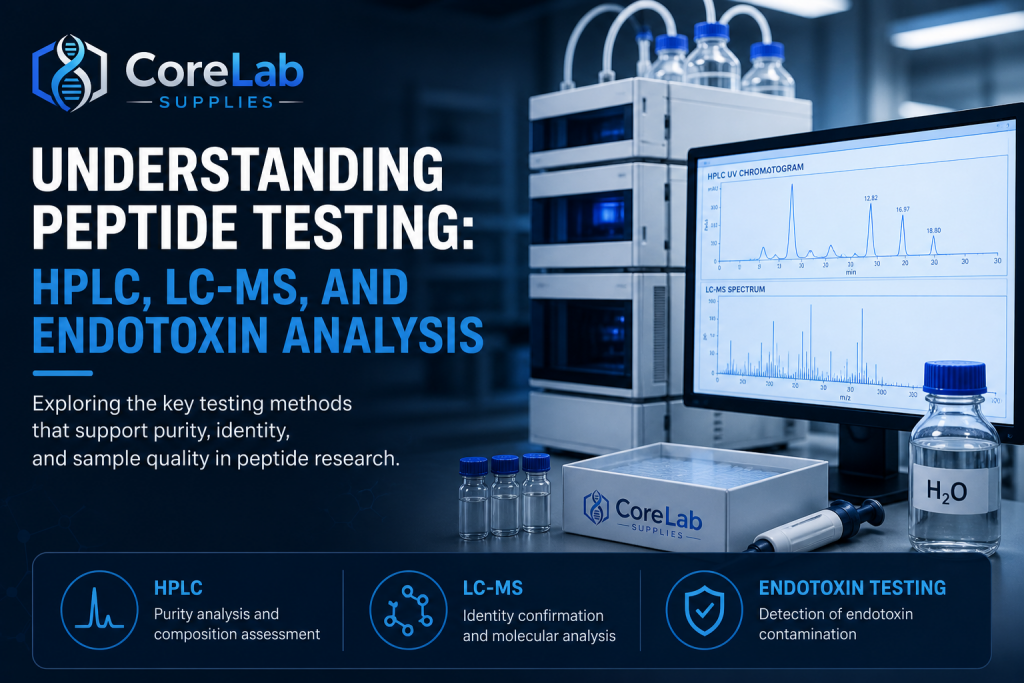
In peptide research, analytical testing plays a critical role in understanding what is actually being worked with. While labels and documentation provide an overview, laboratory testing methods such as HPLC, LC-MS, and endotoxin analysis offer deeper insight into purity, identity, and overall sample quality.
Understanding how these methods work — and what they reveal — is essential for maintaining accuracy and consistency in research environments.
1. What Is HPLC Testing?
High-Performance Liquid Chromatography (HPLC) is one of the most widely used methods in peptide analysis.
It is primarily used to:
- Assess purity levels
- Detect impurities or by-products
- Provide a percentage breakdown of sample composition
HPLC works by separating components within a sample and measuring how they interact under controlled conditions.
Why it matters in research:
- Helps confirm consistency between batches
- Identifies unwanted compounds
- Supports reproducibility in experimental work
2. What Is LC-MS Testing?
Liquid Chromatography–Mass Spectrometry (LC-MS) combines separation (LC) with mass analysis (MS).
It is used to:
- Confirm molecular identity
- Verify the correct compound is present
- Detect structural variations
While HPLC shows purity, LC-MS confirms what the compound actually is.
Why it matters in research:
- Ensures the correct peptide is being studied
- Detects mislabelled or incorrect compounds
- Adds a deeper level of analytical verification
3. HPLC vs LC-MS: What’s the Difference?
These two methods are often used together.
Method. Purpose
HPLC Measures purity & composition
LC-MS. Confirms molecular identity
Together, they provide a more complete understanding of a sample.
4. What Is Endotoxin Testing?
Endotoxin testing is used to detect bacterial by-products (endotoxins) that may be present in a sample.
Even trace levels can:
- Affect experimental conditions
- Introduce unwanted variables
- Impact overall reliability of results
Why it matters in research:
- Helps ensure sample quality
- Reduces risk of contamination
- Supports controlled experimental conditions
5. Why Multiple Testing Methods Matter
No single test provides a complete picture.
Using multiple methods allows researchers to:
- Assess purity (HPLC)
- Confirm identity (LC-MS)
- Check contamination (endotoxin testing)
This layered approach improves confidence in research materials.
6. The Importance of Verified Data
In peptide research, assumptions can lead to inconsistencies.
Analytical testing provides:
- Measurable data
- Repeatable results
- Greater clarity around sample quality
This is why testing is becoming an increasingly important part of modern research workflows.
Conclusion
HPLC, LC-MS, and endotoxin testing each play a distinct role in understanding peptide samples.
Together, they provide a more complete and reliable picture — supporting consistency, accuracy, and informed research practices.
As peptide research continues to evolve, the importance of proper analytical testing will only increase.
For those interested in independent peptide analysis, CoreLab is developing UK-based testing services focused on HPLC, LC-MS, and endotoxin analysis. Also with a online verification portal
🔬 CoreLab UK Testing Platform – Coming Soon
As demand for transparency and analytical verification continues to grow, CoreLab is developing a UK-based peptide testing platform designed to provide independent analysis through established laboratory methods.
This service will include:
- HPLC purity analysis
- LC-MS identity confirmation
- Optional endotoxin testing
Our aim is to create a structured, accessible process for researchers to submit samples and receive clear, batch-specific data.
More details on how this platform will operate — including submission, turnaround times, and reporting — will be available soon.