
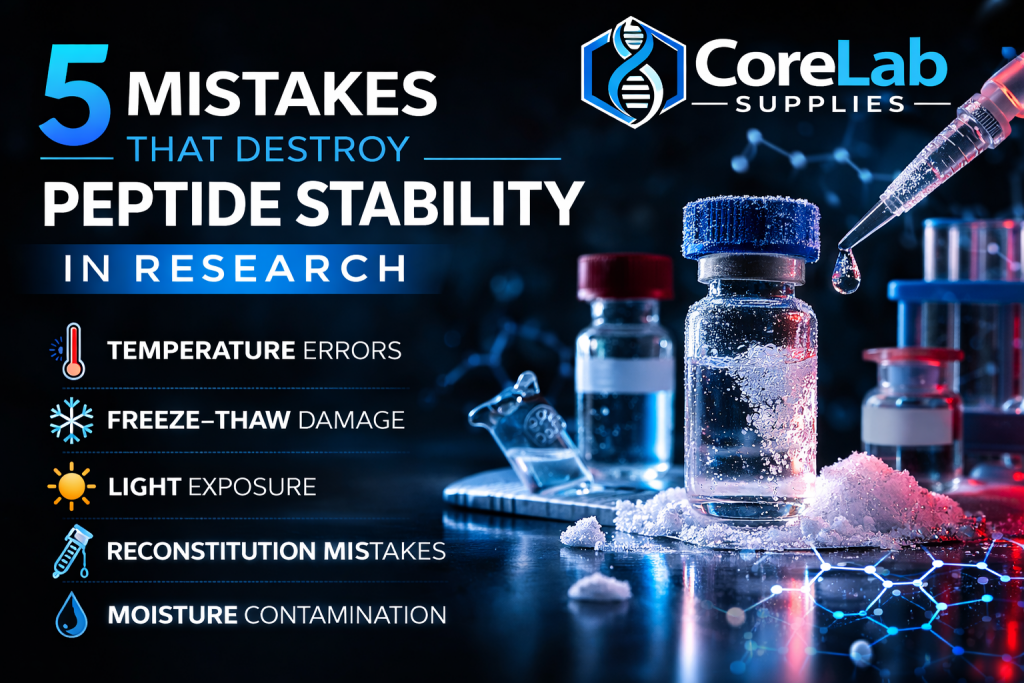
5 Mistakes That Destroy Peptide Stability in Research
Peptides are highly sensitive biological molecules.
Even small mistakes in storage or handling can alter their structure and compromise experimental reliability.
While peptides are widely used in laboratory research, improper handling remains one of the most common causes of degradation.
Understanding the factors that affect stability helps researchers protect the integrity of their materials and maintain consistent results.
1. Storing Peptides at Incorrect Temperatures
Temperature is one of the most important stability factors.
Lyophilised peptides are generally stable when stored in cool, dry conditions. However, prolonged exposure to higher temperatures can accelerate degradation reactions.
Recommended laboratory practice typically includes:
• Refrigerated storage for short-term use
• Freezer storage for long-term preservation
• Avoiding unnecessary temperature fluctuations
Maintaining a controlled environment reduces molecular breakdown.
2. Repeated Freeze–Thaw Cycles
Repeatedly freezing and thawing peptides can cause structural stress.
Each cycle can contribute to:
• Aggregation
• Hydrolysis
• Reduced molecular stability
In laboratory settings, researchers often divide material into smaller aliquots to minimise repeated freeze–thaw exposure.
3. Exposure to Light
Certain amino acids are sensitive to ultraviolet and visible light.
Prolonged light exposure can lead to oxidative changes that alter peptide structure.
For this reason, peptides are commonly stored in:
• Amber vials
• Light-protected containers
• Dark refrigeration environments
Protecting samples from light helps preserve molecular integrity.
4. Improper Reconstitution Technique
When peptides are reconstituted, improper technique can affect stability.
Common issues include:
• Vigorous shaking
• Using unsuitable solvents
• Introducing contamination
Gentle mixing and sterile technique are typically recommended to maintain structural integrity.
5. Moisture Exposure
Lyophilised peptides are highly sensitive to moisture.
Water exposure before reconstitution can initiate hydrolysis and reduce stability.
To prevent this, peptides are typically stored in sealed containers with minimal exposure to atmospheric humidity.
Why Stability Matters in Research
Peptide degradation can influence experimental outcomes by altering receptor binding, signalling pathways, or assay reproducibility.
Maintaining proper storage and handling procedures helps ensure reliable results.
Conclusion
Peptide stability depends heavily on environmental control and proper laboratory technique.
Avoiding common mistakes — such as improper temperature storage, light exposure, and repeated freeze–thaw cycles — helps preserve molecular integrity and supports reliable research outcomes.
Research Materials
To explore available compounds used in peptide research, visit our research materials section, where you can view detailed information and laboratory specifications.
Continue Exploring Peptide Research
Understanding peptide stability is just one part of responsible research practices.
For a deeper understanding of the science behind peptides, you may also find these articles helpful:
• What Are Research Peptides? – An overview of peptide structure and their role in biological research.
• How Peptides Work in Biological Systems – A closer look at receptor interaction and cellular signalling.
• Why Peptide Purity and HPLC Testing Matter in Research – Understanding analytical verification and molecular quality control.
• Peptide Stability: Temperature, Light and Storage Factors – How environmental conditions influence peptide integrity.