
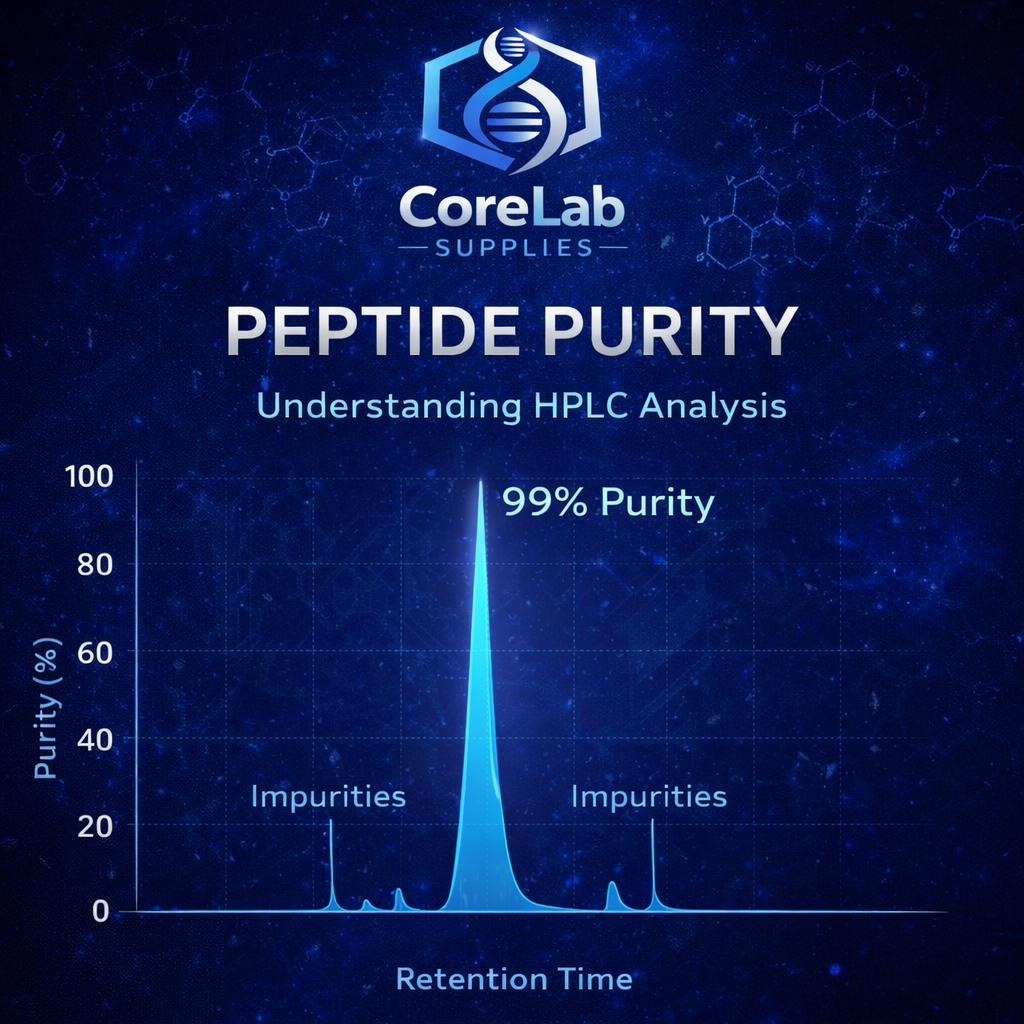
Peptide purity is one of the most commonly referenced metrics in research, yet it is often misunderstood. Purity percentages are frequently used to describe the quality of a peptide, but these numbers do not always tell the full story.
Understanding how peptide purity is measured — and what those values actually represent — is essential for interpreting analytical data and maintaining consistency in research environments.
What Is Peptide Purity?
Peptide purity refers to the proportion of the desired peptide relative to other components present in a sample.
These additional components may include:
• incomplete peptide sequences
• synthesis by-products
• degradation products
• chemical impurities
Purity is typically expressed as a percentage, indicating how much of the sample corresponds to the target peptide.
How Purity Is Measured (HPLC)
Peptide purity is most commonly measured using High Performance Liquid Chromatography (HPLC).
In this process:
The peptide sample is dissolved in a solvent It passes through a chromatographic column Different components separate based on chemical properties A detector records peaks representing each compound
The resulting chromatogram provides a visual representation of the sample composition.
Interpreting Purity Percentages
Purity percentages are based on the area of the main peak in the chromatogram.
For example:
• 95% purity → 5% of the sample consists of other components
• 98–99% purity → significantly fewer impurities
• <95% purity → higher presence of by-products or fragments
However, it is important to understand:
👉 The remaining percentage is not always a single impurity
👉 It may consist of multiple small components
High Purity Peptides (99% and Above)
In some research settings, peptides are produced with very high purity levels, typically 99% or above like CoreLab Retatrutide 20mg which is 99%+ purity
At this level:
• the main peptide peak dominates the chromatogram
• only trace levels of impurities are present
• overall sample composition is more defined
Higher purity peptides are often preferred in research where:
• precise molecular interaction is being studied
• reduced interference is important
• consistent experimental conditions are required
However, it is still important to recognise that:
👉 even at 99% purity, trace impurities may still exist
👉 analytical verification remains essential
Why Higher Purity Matters in Research
Higher purity generally provides:
• more consistent experimental conditions
• reduced interference from impurities
• improved reproducibility
• clearer interpretation of results
Impurities, even in small amounts, can introduce variables that affect outcomes in sensitive research settings.
Limitations of Purity Percentages
While purity percentages are useful, they do not provide complete information on their own.
Important considerations include:
• the type of impurities present
• detection sensitivity of the method
• differences between analytical techniques
• whether data is independently verified
This is why analytical reports are often reviewed alongside purity values.
Analytical Data Beyond Purity
In addition to HPLC, researchers may consider:
• mass spectrometry (molecular weight confirmation)
• chromatogram shape and peak clarity
• batch-specific documentation
These factors provide a more complete understanding of peptide quality.
Conclusion
Peptide purity is an important metric in research, but it should be interpreted within the context of analytical data and testing methods.
Understanding how purity is measured and what those percentages represent allows researchers to make more informed decisions and maintain consistency in their work.
Research Materials
To explore compounds commonly studied in peptide research, visit our research materials catalogue for further information.