
How Peptides Work in Biological Systems
Introduction
Following our overview of research peptides, the next logical question is:
How do peptides actually function within biological systems?
Peptides are not random molecules — they act as highly specific signalling agents that interact with receptors, enzymes, and cellular pathways.
Understanding this mechanism explains why they are widely studied in laboratory research.
Peptides as Signalling Molecules
In biological systems, peptides often act as:
Hormones Neurotransmitters Growth factors Regulatory messengers
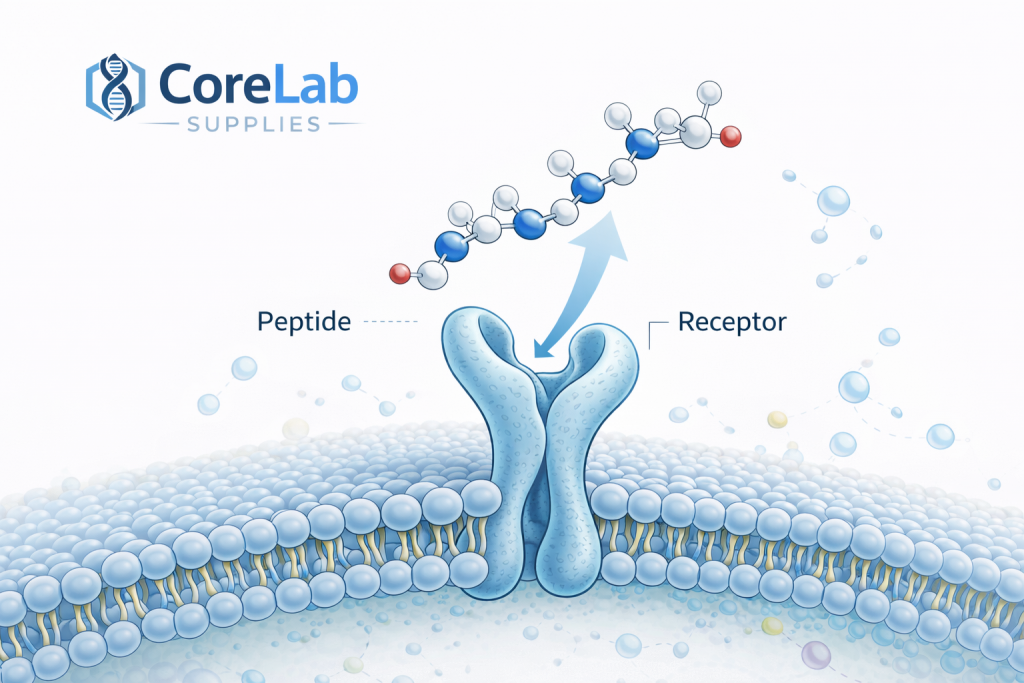
They bind to receptors on the surface of cells or within cells, triggering biochemical responses.
This receptor-binding specificity is what makes peptides so interesting in research environments.
Receptor Binding and Activation
Most peptide activity begins with receptor interaction.
The process typically follows this sequence:
1 – Peptide approaches target receptor
2 – Binding occurs based on molecular compatibility
3 – Receptor changes shape (conformational shift)
4 – Intracellular signalling cascade begins
These cascades can influence:
Gene expression Enzyme activity Metabolic pathways Cellular communication
Selectivity and Precision
One reason peptides are studied extensively is their high selectivity.
Unlike small-molecule compounds that may affect multiple systems, peptides often demonstrate:
Targeted receptor affinity Predictable pathway activation Reduced off-target interaction (in controlled settings)
This precision is valuable in experimental modelling.
Peptides vs Proteins
While peptides and proteins are both made of amino acids, size influences function.
Peptides: Typically 2–50 amino acids Proteins: Larger, more complex structures
Shorter peptide chains can often act faster in signalling roles due to structural simplicity.
Stability and Biological Activity
For peptides to function effectively in research models, structural integrity must be maintained.
Degradation can alter:
Binding affinity Molecular charge Structural conformation
This is why proper storage and purity verification are critical in laboratory settings.
Learn more about what research peptides are and how they are supplied in laboratory environments.
Conclusion
Peptides operate as precise molecular messengers within biological systems.
Their ability to selectively bind receptors and initiate signalling cascades makes them valuable tools in laboratory investigation.
Understanding their functional mechanism provides context for why stability, purity, and controlled handling matter in research.
FAQ
Why are peptides considered precise signalling molecules?
Their amino acid sequence determines specific receptor compatibility.
Do all peptides act as hormones?
No. Some function as neurotransmitters, growth regulators, or immune modulators.